Understand
Read a principle and work through a fictional situation.
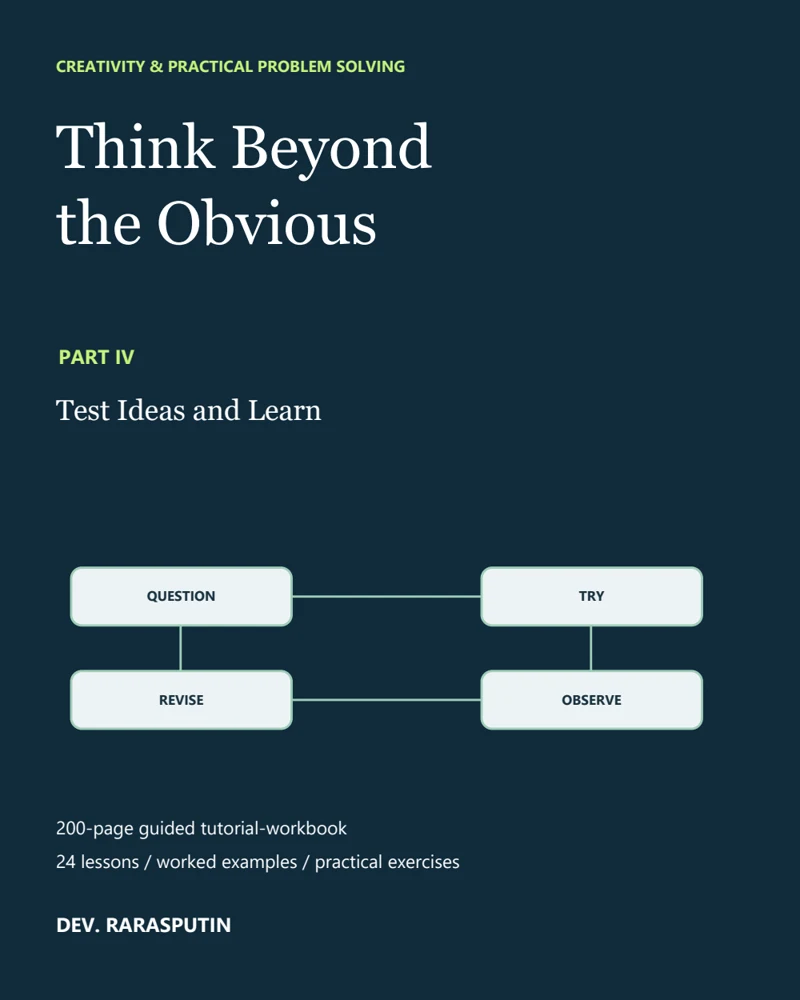
Creativity & practical problem solving / Part IV
Turn promising concepts into prototypes and useful evidence.
200-page tutorial-workbook / 24 lessons / $5 USD
Get Part IV - $5Substantial guided writing and planning space. PDF plus practical templates; each part is sold separately.
Learn by doing
Read a principle and work through a fictional situation.
Inspect two routes and the assumptions behind them.
Apply the skill to one manageable real challenge.
Record evidence, limits and your next useful decision.
A fictional worked example
Asha wants feedback on a new arrival guide but asks only whether it looks nice.
The real question is whether a newcomer can locate the entrance using the guide.
A simple walkthrough can inform the design before visual polishing.
Illustrative teaching example, not a testimonial or measured result.
Explore the sample lessonInside this volume
A test is more useful when it answers one consequential question. Separate learning from presenting a finished idea. Decide what the result could change before making the prototype.
Try it: Write one learning question for a leading idea.
Check: What would you change after either possible answer?
A hypothesis connects an intervention with an expected observation in a context. Keep it modest and specific. A small practical test can inform a decision without proving a general causal law.
Try it: Write a hypothesis without using better, engaging or successful alone.
Check: What observation would count against the prediction?
A prototype is a representation built to answer a question. Include enough realism for the task and omit unrelated features. The best level of detail depends on what you need to learn.
Try it: List the minimum elements your learning question requires.
Check: Which omitted element would invalidate the test?
Paper can represent a page, sequence, card or service touchpoint before software exists. Explain what is simulated and invite people to act through the task. Keep real-world commitments out of the simulation.
Try it: Create two paper versions of the same information task.
Check: What did the participant do rather than merely say they liked?
A storyboard can help people inspect the sequence and point out unrealistic transitions. Ask where the story differs from their experience. It is especially useful before a service exists.
Try it: Ask someone to mark the first unrealistic moment in a storyboard.
Check: Which transition relies on a condition you have not verified?
Role-play reveals timing, handoffs and exceptions that a diagram may omit. Assign roles and make the scenario clear. Participants should understand it is a rehearsal, not a real offer or commitment.
Try it: Rehearse a normal and an exception case with willing participants.
Check: Where did the service depend on unstated knowledge?
A task should describe what the person needs to accomplish without naming the control or route being tested. Otherwise you can accidentally coach success. Use consistent wording when comparing versions.
Try it: Rewrite three leading tasks in neutral language.
Check: Does the task reveal the answer you want the person to find?
A person who performs the target task can reveal issues an expert friend misses. Describe whom the test is relevant to and the limits of the sample. Invite participation without pressure.
Try it: Write a short, respectful invitation and selection rationale.
Check: Which important experience is absent from your sample?
People should know what they are trying, what you will record and that they may stop. Keep the activity proportionate and avoid collecting identifiers you do not need. Use fictional details for simulations.
Try it: Write a plain introduction for a short voluntary test.
Check: What information can you avoid collecting entirely?
Intervening immediately can hide the difficulty the test is meant to reveal. Allow a reasonable attempt, then help if needed and record the help. Keep the participant's comfort in view.
Try it: Plan what you will observe and when you would intervene.
Check: Which part was completed without your explanation?
A comment expresses a person's view; a behavior records what they did in the task. Both are useful but answer different questions. Preserve the difference in notes.
Try it: Create three note columns: action, comment and interpretation.
Check: Which conclusion is supported by action and which by opinion?
Two versions can be compared when the difference is clear and relevant. Keep other conditions similar where practical. A small informal comparison is exploratory, especially if order or participant differences influence results.
Try it: Describe one contrast and the factors you will hold steady.
Check: What feature are you actually comparing?
The useful measure depends on the question. Correct completion, unnecessary steps, questions or comprehension may matter more than speed. Define the measure before seeing the result.
Try it: Choose one primary observation and one useful secondary observation.
Check: Could the measure improve while the real experience gets worse?
A decision rule describes what you will do with the evidence. It need not be a statistical threshold for a small learning exercise. Use a rule suited to the stakes and state its limits.
Try it: Write rules for continuing, revising and stopping your trial.
Check: What finding would prevent you from proceeding?
A small test can reveal concrete problems and suggest directions. It rarely supports precise population estimates. Report the observed count and context without inflating the conclusion.
Try it: Rewrite an exaggerated result as a bounded observation.
Check: What does the evidence establish, and what remains open?
A surprise can expose a wrong assumption, an unusual context or a problem with the test itself. Check the setup before explaining away the result. Preserve evidence that contradicts the favorite idea.
Try it: Write three possible explanations for an unexpected result.
Check: Which explanation can be checked next?
A revision should respond to an observed problem and explain what changed. Avoid redesigning unrelated elements because feedback felt disappointing. Keep an earlier version for comparison.
Try it: Create a revision note linking an observation to a change.
Check: How should the revision change the person's next action?
Versions let you connect a result to the exact artifact tested. Record dates, content changes and important conditions. Without this trail, feedback can refer to a design that no longer exists.
Try it: Make a simple version log for one prototype.
Check: Can you reconstruct what the participant actually used?
A pilot tries the arrangement in a limited real context after basic issues are addressed. Specify scope, owner, duration, fallback and review. A pilot is a real operation with consequences, not merely a sketch.
Try it: Write a one-event or one-week pilot plan.
Check: Who can stop the pilot and restore the fallback?
An exception route supports people when the intended path fails. Consider common disruptions before launch. The route should be clear enough for the person encountering the problem and the helper receiving it.
Try it: Plan responses to three likely interruptions.
Check: What happens when the normal route is unavailable?
A change may improve one measure while adding work or confusion elsewhere. Look beyond the primary success condition. Ask who benefits, who carries new effort and what became less reliable.
Try it: Record one benefit, one burden and one unexpected consequence.
Check: Where did the work go after the change?
A review can support adoption, another iteration, a larger test or stopping. Use the learning question and evidence rather than attachment to the effort already spent. Explain what remains uncertain.
Try it: Write continue, adapt or stop with evidence and a limit.
Check: What would you choose if you inherited this evidence today?
A learning report separates the question, method, observation, interpretation and action. Include contradictory findings and limits. Readers should not need to guess whether a result was measured or merely expected.
Try it: Write a one-page account using those five headings.
Check: Could someone distinguish your observations from your conclusions?
A full cycle links a selected idea to a hypothesis, prototype, observation and revision. Keep that chain visible so the next project can reuse the reasoning rather than copying the artifact blindly.
Try it: Create a compact case record with evidence and a next decision.
Check: What principle would transfer, and what must be checked again?
Your working space
Choose a lesson, describe your challenge and keep the reasoning visible. Save stores entries in this browser only. Download a copy for another device. There is no account or cloud sync.
The complete learning path
Each volume contains 200 numbered pages, including substantial practice and writing space. This is a tutorial-workbook series, not a video course or interactive PDF form. Ordinary examples are fictional. Results depend on context, judgment and practice.